Chairperson, Department of Applied Linguistics, GCU, Faisalabad
Exceutive Director, Conferences LAP
Major Theme
Digitalisation of Indigenous Languages
Conference Dates
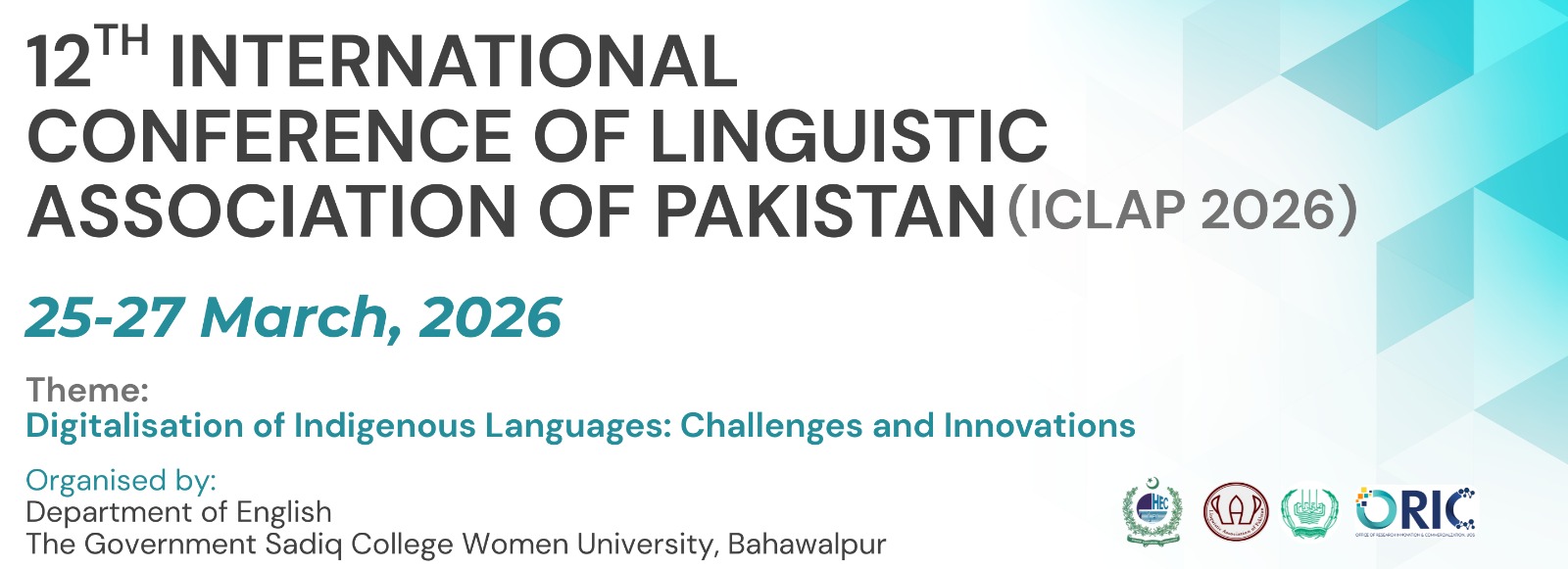
March 25-27, 2026
Location
Bahawalpur, Pakistan
Hosted By
Department of English, GSCWU Bahawalpur
Proposal Deadline
January 10, 2026
Target Audience
Researchers, Faculty, Scholars & Students
Introduction: ICLAP 2026
The Department of English, Government Sadiq College Women University, Bahawalpur
is honored to host the 12th International Conference of the Linguistics Association of Pakistan (ICLAP 2026),
scheduled for March 25-27, 2026. This is for the very first time that the university is hosting this prestigious event.
ICLAP 2026 looks forward to convening distinguished linguists, academics, technology experts, and professionals
from around the globe and across Pakistan. The conference program will feature keynote and plenary sessions,
technical lectures, workshops, panels, colloquia, paper presentations, and a book launch, along with
cultural festivities-providing a comprehensive platform for knowledge sharing, collaboration, and learning.
Aims of ICLAP 2026
ICLAP 2026 aims to bring together linguists, educators, and technologists from across the globe
to discuss the challenges and possible innovations in the digitalization of indigenous languages.
The conference seeks to advance research in AI-driven language technologies, promote sustainable
practices for documenting and revitalizing endangered and indigenous languages, and examine how
digital tools can be exploited for the preservation of cultural identity through technological advancements.
It further aims to strengthen multilingual and indigenous language education through digital tools,
critically engage with the politics of linguistic rights and equitable access, and reflect on the evolving
role of linguistics in the age of AI.
By fostering inclusive communication, accessible digital platforms, and international collaboration,
the conference aspires to support a linguistically just, technologically progressive, and socially
sustainable future for indigenous language communities across the globe.
Target Audience
The ICLAP 2026 invites academicians, researchers, linguists, professionals and post/graduate students from a variety of disciplines (listed below) from across the country and beyond. We encourage and welcome participation and presentations at ICLAP 2026, focusing on cross-disciplinary and multidisciplinary ideas, issues, perspectives, and developments specifically pertaining to the integration of technology and indigenous languages and generally to the areas of:
Languages and Literature
Theoretical & Applied Linguistics
Sociolinguistics
Psycholinguistics
Humor Linguistics
Language Education & Literacy Studies
TESOL
Education
Higher Education
Computer Science
Artificial Intelligence
Educational Technology
Computational Linguistics
NLP
Translation & Interpreting Studies
Anthropology
Public Policy
Gender Studies
Media Studies
Sociology
Media & Discourse
Development Studies
Community Development
Speech Recognition and Assistive Technologies
Communication Studies
Cyber-Linguistics & Online Communication
Migration Studies
THEMES
The proposed themes for the conference include, but are not restricted to:
1. Digitalization and Indigenous Cultural Identity
Digitalization and Preservation of Indigenous Cultural Identity
Storytelling as a Tool for Preserving Indigenous Identity
Online Representation of Indigenous Languages in Social Media Communities
Intergenerational Knowledge Transfer Through Digital Archives and Apps
The Role of Digital Literature and Film in Revitalizing Indigenous Languages
Hybrid and Exophonic Writing Practices in Digitally Mediated Indigenous Literatures
Gendered Expressions of Indigenous Identity in Digital Spaces
2. Artificial Intelligence and Indigenous Language Education
AI-Based Learning Platforms for Teaching Indigenous Languages
Developing Speech-to-Text & Text-to-Speech Models for Low-Resource Indigenous Languages
EdTech Solutions for Indigenous Language Education in Remote and Rural Regions
NLP-Assisted Creation of Indigenous Language Textbooks and Learning Content
The Role of Neurolinguistic Programming in Indigenous Language Acquisition
Assistive Technologies for Inclusive Indigenous Language Learning
3. Language Policy, Linguistic Rights, and Governance in the Digital Era
Digital Language Policy: Ensuring Indigenous Language Access in Online Platforms
Governance Models for Integrating Indigenous Languages into Digital Public Services
Legal Frameworks for Indigenous Linguistic Rights in the Digital Age
Evaluating Digital Curriculum Policies for Indigenous Language Inclusion
Power Structures and Ideologies in Digital Language Policies
AI-Driven Interventions for Strengthening Linguistic Justice
Language Policy and Planning for Education and Linguistic Equity
Case Studies on Pakistan's Linguistic Landscape
National and Institutional Strategies for Linguistic Resources
Policy Frameworks for Digitally Preserving Linguistic Diversity
The Role of AI in Facilitating Linguistic Justice and Access
4. Digital Preservation and Sustainability of Endangered/Indigenous Languages
Developing Digital Corpora for Endangered Indigenous Languages
Balancing National Language Promotion with Minority Language Preservation
Digital Tools for Translation and Cross-Cultural Collaboration
Community-Led Approaches Using Mobile Technologies
Digital Lexicography and Online Indigenous Dictionaries
Eco-Linguistics and Digital Sustainability
AI Techniques for Phonological and Morphological Analysis
Technology-Based Strategies for Language Revitalization
Making Digital Spaces Inclusive for Marginalized Groups
5. Digital Accessibility, Economic Empowerment, and Indigenous Languages
Multilingual AI Translation Tools for Economic Participation
Digital Entrepreneurship for Indigenous Language Communities
Enhancing Workforce Skills Through Indigenous-Language Platforms
Reducing the Digital Divide Through Accessibility Solutions
Indigenous Languages in Digital Financial & E-Governance Systems
Inclusive Digital Services for Low-Literacy Populations
Language & Misinformation Challenges
Cyber-Linguistics in Digital Interactions
Pakistani Indigenous Languages in the Digital Age
6. Digital Sociolinguistics and Power Dynamics
Impact of Social Media on Indigenous Languages
Cyber-Linguistics: New Indigenous Digital Communication
Indigenous Voices in Digital Activism
Digital Misinformation Dynamics in Communities
Changing Linguistic Norms in Online Environments
Digital Ethnography of Indigenous Virtual Communities
7. Multilingual Pedagogy and Indigenous Language Integration
Integrating Indigenous Languages into Digital Multilingual Classrooms
Translanguaging Practices in Online Education
TESOL Approaches for Indigenous and Multilingual Learners
Recognizing Indigenous Varieties in Global Englishes
Bilingual and Heritage Language Education via Digital Tools
Emotional & Identity Impacts of Digital Language Learning
8. Interdisciplinary Pathways: Language, Technology, and Sustainable Development
Digital Health Communication Systems Supporting Indigenous Languages
Ethical AI Design for Indigenous Communities
Indigenous Language Integration for Migrants and Displaced Groups
Urban-Rural Linguistic Sustainability Through Technology
Cross-Sector Collaborations for Digital Development
9. Transforming Linguistics Education Through Digitalization
Integrating Computational Linguistics into Indigenous Language Studies
Digital Fieldwork Methods
Curriculum Innovations in Applied Linguistics
Training Students in Corpus Building and Annotation
Preparing Graduates for AI, Tech, and Policy Careers
University-Led Digital Revitalization Initiatives
Speakers
International Speakers
Dr. Ahmar Mahboob
Associate Professor, Department of Linguistics
University of Sydney, Australia
Dr. Shobhana Chelliah
Professor of Linguistics
Indiana University, Bloomington, USA
Dr. Salvatore Attardo
Professor, Department of Literature & Languages
East Texas A&M University, USA
Dr. Nicanor Guinto
Associate Professor & Director, Office of Research Services
Southern Luzon State University, Philippines
Dr. Christian F. “Kiki” Hempelmann
Professor of Computational Linguistics
East Texas A&M University, USA
National Speakers (Pakistan)
Dr. Tafseer Ahmed Khan
Professor, Department of Computer Science
Mohammad Ali Jinnah University, Karachi
Dr. Muhammad Kamal Khan
Associate Professor of English & Applied Linguistics
AIOU, Islamabad
Prof. Dr. Qaisar Khan
Professor of English & Chairperson
University of Malakand
Dr. Aalia Sohail Khan
Director, AIPS-Pakistan
Former VC, Women’s University Rawalpindi
Zubair Torwali
Researcher & Language Activist
IBT, Swat
Prof. Dr. Sajida Zaki
Professor of English & Applied Linguistics
NED University, Karachi
Dr. Fauzia Janjua
Dean, Faculty of Languages & Literature
IIUI, Islamabad
Prof. Dr. Nasir Abbas
Dean & Head of Department
LUAWMS, Uthal, Balochistan
Call for Proposals
Submit your abstract...
Conference Committees
Scientific Committee
Chair: Prof. Dr. Rashid Mahmood
Co-Chair: Dr. Asma Kashif Shehzad
Prof. Dr. Asif Khan
Dr. Tehseen Zahra
Dr. Humaira Jehangir
Dr. Farrukh Arsalan
Dr. Aniqa Rashid
Mr. Qasim Dad
Dr. Ayesha Ashraf
Ms. Aneeqa Ahmed
Publication Committee
Chair: Prof. Dr. Asif Khan
Co-Chair: Ms. Noshaba Ejaz
Ms. Ayesha Sajid Durrani
Ms. Taila Javad
Ms. Maira Naseem
Dr. Anum Hanif
Media & Communication Committee
Chair: Dr. Barira Nazeer
Co-Chair: Ms. Ayesha Sajid Durrani
Ms. Shaista Hassan
Ms. Maira Naseem
Ms. Kainat
Ms. Ushna Maryam Khan
Ms. Wardah Azhar
Program Committee
Chair: Dr. Azher Pervaiz
Co-Chair: Dr. Nida Zahra
Dr. Sana Nawaz
Ms. Fatima Iqbal
Ms. Qurat ul Ain
Ms. Samina Shehzad
Ms. Nabila Shafique
Ms. Abeeha Khan
Reception & Coordination Committee
Chair: Dr. Saba Sadia
Co-Chair: Dr. Breya Sial
Ms. Abiha Khan
Ms. Fatima Iqbal
Ms. Anum Sajid
Registration & Finance Committee
Chair: Dr. Breya Sial
Co-Chair:Ms. Mariam Akram
Ms. Kainat
Ms. Ittrat Zahra
Ms. Hunain
Important Dates
Proposal Submission Deadline: 10th January, 2026
Notification of Acceptance: 20th January, 2026
Registration Opens: 20th January, 2026
Conference Days: March 25-27, 2026
Program & Schedule
Conference schedule...
Conference Fee
Presenter
National (Faculty): 3,500 PKR
National (Students): 2,500 PKR
International: 60 USD
Participant
National (Faculty): 3,000 PKR
National (Students): 2,000 PKR
International: 40 USD
Bank Account Information
Institution:
Sadiq Women University
(The Government Sadiq College Women University, Bahawalpur)
Bank: Habib Bank Limited (HBL)
Account Title: UZMA NAHEED / BREYA
Account Number: 0025017000642399
IBAN: PK31 HABB 0025 0170 0064 2399
Register Now
Secure your participation in ICLAP 2026 by completing your registration through our official conference portal.
Presenters and participants must register before the deadline to ensure inclusion in the program.
For assistance or technical support, please contact: itsystemslap@gmail.com
Venue
The Government Sadiq College Women University, Bahawalpur is the host venue of
the 12th International Conference of the Linguistic Association of Pakistan (ICLAP 2026).
Located in the historic city of Bahawalpur, the university provides a vibrant academic environment,
modern facilities, and a welcoming campus for national and international delegates.
The campus offers well-equipped lecture halls, seminar rooms, and conference spaces
suitable for keynote sessions, parallel presentations, and academic networking.
As part of the cultural program of ICLAP 2026, conference participants will visit
Noor Mahal, Bahawalpur, one of the most iconic historical and architectural landmarks
of Punjab, Pakistan.
Constructed in 1872 during the reign of Nawab Sir Sadiq Muhammad Khan IV,
Noor Mahal represents a remarkable fusion of Italian and
neoclassical European architectural styles, reflecting the cultural refinement and
royal heritage of the former Bahawalpur State.
Originally conceived as a royal residence, the palace later functioned as a state guest house and
is now preserved as a national heritage site. Its grand domes, spacious halls, marble staircases,
and meticulously designed interiors vividly portray the opulence of the Nawabi era.
Located near the city center, Noor Mahal stands as a symbol of Bahawalpur’s historical significance
and architectural excellence, offering visitors a meaningful insight into the region’s rich cultural
legacy. During ICLAP 2026, guests will have the opportunity to experience this historic
site as part of the official conference tour.
Tour Location: Noor Mahal, Bahawalpur
Sponsors
Sponsors info...
Publications
Publications info...
Contact
Contact info...
Call for Abstracts
12th International Conference of Linguistic Association of Pakistan
ICLAP 2026
Hosted by the Department of English
Government Sadiq College Women University, Bahawalpur
25 – 27 March 2026
Conference Theme
Digitalization of Indigenous Languages: Challenges and Innovations